Thriving in the Wasteland: What the Namib Taught Me About God and Faith
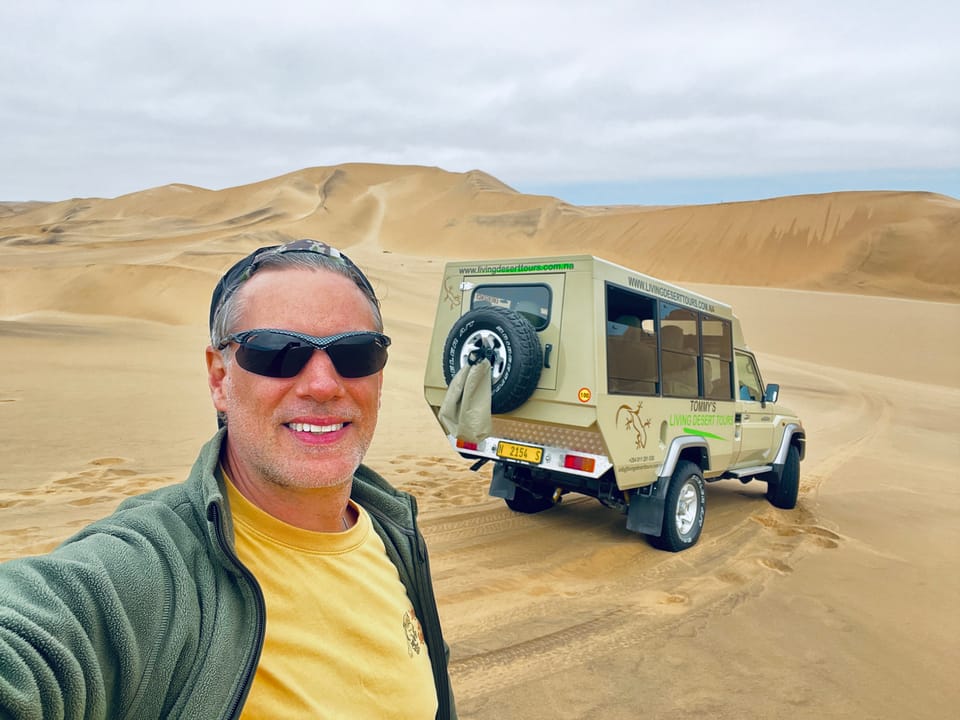
Kicking up sand and tearing across the Namib Desert in a Land Cruiser was my idea of adventure. A few years ago, I had the chance to visit Africa's southwesternmost country, known for its vast sand dunes, dramatic coastline, and unique wildlife in Etosha National Park.
But the main reason we were climbing the waves of reddish, iron-rich sand in our built Toyotas full of tourists wasn't to dune bash. We were hunting life in the arid expanse. I was on a Living Desert Tour, and our group was out to see the hardy creatures that live there.
But what could survive in this place? Could anything thrive? It was, after all, a desert – but not just any – the Namib is considered the oldest in the world. To the casual observer, coarse sand and a steady, arid breeze made the land uninhabitable. Gazing over the surface, it was a breathtaking wasteland.
Our guides were confident that a sundry of little reptiles and other animals dwelt in this lonely area, so much so that they planned an entire tour around it. If I hadn't paid to see the wildlife here, I wouldn't have believed it.
Without the right kind of eyes, you'd never see life.
We crept along in our tan SUVs while our expert guides scoured the sand. Suddenly, they would spot a unique zigzag carved on the surface or a tiny hole peeking out of the ground and jump out to investigate. We watched in awe as they knelt and carefully dug out a remarkable translucent gecko buried beneath the sand. Another time, they called us out to see a stone-colored sidewinder snake slowly burying itself in the sand.
Life teemed in the desert, but you needed to know where to look.
What's the Meaning of Our Desert?
The physical desert has much to teach us about how life can flourish in dry places. What about the metaphorical deserts of life? What can they teach us, and where can we find nourishment?
These seasons happen when your soul feels parched, you are weary, and need God's nourishment more than ever. They are often filled with loneliness, desolation, struggle, and questions – lots of questions, like Where are you, God? Why me, Lord? What am I supposed to learn here?
It's difficult to hear God and understand what He's doing in the barrenness because your soul is hungry and thirsty. Even if you know how the Spirit is working, getting through the wasteland is tough.
In the words of King David in the first part of Psalm 13:
O Lord, how long will you forget me? Forever?
How long will you look the other way?
How long must I struggle with anguish in my soul,
with sorrow in my heart every day?
In these challenging times, God's love and unfailing grace pits themselves against our circumstances. Our faith is tested. Hope flickers. We face unwanted circumstances like sickness, financial struggles, or unfulfilled desires. Deserts force us to choose – do we believe the Lord is good regardless of what happens?
One of my friends is trudging through a critical illness as we speak. He's a man of God and a middle-aged leader with an influential ministry. His desert affects every part of his life, physically, emotionally, and spiritually. My friend's faithful wife stays by his side, but she's facing her own desert.
Everyone's experience here is different. Some must crawl through the "valley of death" for a long time, while it seems to be in and out quickly. There's no need to compare one personal desert with another. Each is unique, like a fingerprint on the blistered hand of the soujourner. The crosses we must carry come in all shapes and sizes.
The Desert and Scripture
Scripture mentions actual deserts many times, but, just like for us, they hold much deeper meaning than only being a biome. For Moses, the desert was a holy place where God spoke to Him. The Israelites wandered in the same desert for forty years, being tested and prepared for the Promised Land. Likewise, Elijah fled to it to find refuge after being chased by Jezebel.
Deserts are paradoxical because their barrenness and discomfort are their blessings. The scarcity of animals and plants brings quietness; quietness fosters focus, and focus leads to clarity. Clarity brings peace.
In the third and fourth centuries, some early ascetics, such as Anthony the Great, moved to the desert to be closer to God. They believed deserts remove distractions. Monks like these became known as the Desert Fathers and desired to pray, fast, and lead Spartan lives without interruption. In essence, they want to keep life simple and prepare for the afterlife.
Anthony is quoted as saying, "He who wishes to live in solitude in the desert is delivered from three conflicts: hearing, speech, and sight; there is only one conflict for him and that is with fornication."
Deserts are also places of quests, like the one Santiago went on in The Alchemist, by Paul Coelho. Could the protagonist really have fulfilled his spiritual journey and learned to listen to his heart if not in the Sahara?
Deeper still, the elements of your heart are exposed in the desert. Nothing is hidden here. Your vulnerability means God sees you and can protect you. Food and water are scarce – your sustenance comes from the Lord alone.
To remove the sting of desert life is to remove its blessing.
Are you in a desert now? I am – a sustained one. Mine is decades of adulthood, singleness, and a longing to find my true purpose. Though I have done many significant things in my life, I want to make a difference in the world and be married.
Here are four lessons you can learn in the desert.
Truth #1: God is With You in the Desert
Though your feelings of abandonment or despair might argue, there's no place you can go without His presence. Just like He was with Israel the entire time as they wandered, guiding them with a pillar of cloud by day and one of fire by night, He is with you, as well.
David writes in Psalm 139:7-8.
Where can I go from your Spirit?
Where can I flee from your presence?
If I go up to the heavens, you are there;
if I make my bed in the depths, you are there.
Whatever your feelings might say, God is right beside you in the wilderness, not least of which because you are a temple of the Holy Spirit. Forget why you're there for a moment. Concentrate on the Lord who is keeping you. Let Him speak to your heart: "He will neither fail you nor abandon you" (Deuteronomy 31:6).
Similarly, when His disciples encouraged Jesus to eat in John 4, He replied, "I have a kind of food you know nothing about.” That's desert-speak for being by nourishment you cannot see. Eat that.
Just like God provided manna and quail in the desert for Israel, he is providing for you in your own desert.
Truth #2: Take Your Time in the Desert
Deserts are uncomfortable, and we want to rush through them. But many times an escape route is outside of our control, and maybe it's not God's Will right now for your life. Whatever your individual circumstances, take your time. Accept where you're at – the desert place of scarcity on the surface, but of deep abundance below. Get everything the Lord has for you here before you want to move out.
Like Jacob, wrestle with God and don't settle for leaving until God blesses you with a special desert blessing. (Hint: There may be more than one.)
Embrace the season. Accept it. That doesn't mean to stop praying for deliverance, but don't let your outcry drown what He wants to say to you. Change your prayer life from Lord, get me out of this desert! to Lord, how do you want to provide in the special place? What can I learn here that I couldn't otherwise?
You’ll find something special in the desert that only it can give you.
Truth #3: Scripture is Your Anchor in the Desert
Again, being crestfallen doesn't mean you can't trust in God at the same time. If emotions are your final decision-maker in life instead of God's character, you're going to have a roller-coaster spiritual life at best and a terrible one at worst.
Rest on what the Bible says about who God is. When I feel alone, I read about the Heroes of Faith in Hebrews 12.
- It was by faith that the people of Israel went right through the Red Sea...
- It was by faith that Abraham offered Isaac as a sacrifice...
- It was by faith that Moses left the land of Egypt...
- It was by faith that the people of Israel went right through the Red Sea...
- It was by faith that the people of Israel marched around Jericho...
As Christian Philosopher Dallas Willard noted, "Faith is not opposed to knowing, it's opposed to sight." God is there, even when you can't see him.
Truth #4: You Can Thrive in the Desert
In one of my favorite fantasy movies, Dune, a people group called the Fremen inhabit a vast desert planet named Arrakis. The Fremen were born there and know how to thrive in the desert. It's their home.
You can thrive in the desert, too, not just survive it. But you'll need to learn the ways of the desert, like the protagonist, Prince Paul Atreides, had to when he traveled there.
John the Baptist became spiritually strong in the desert and preached about the coming Savior from there. And what about our Lord Jesus? Could He have been "filled with the Holy Spirit’s power" if not for being tempted and dwelling in the desert for forty days? (Luke 4:14). Indeed, living in a city would not do this.
What Do Your Eyes See?
Are you in a season of dryness where the Lord has you? Your oasis will be His unfailing love and provision.
Trusting in God in these dry seasons doesn't mean downplaying your circumstances. Some of you reading this are dealing with circumstances that would crush a nonbeliever. But know the One who sustains you, who provides water from a rock. You know Jesus, the Bright Morning Star, the Prince of Peace, one whose light shines in the darkest places and whose peace passes all understanding.
What do your eyes see when you look at the desert now? A land of despair or a land of opportunity? Can you begin to see what blessings dwell under the sand?
Welcome to the desert. You are standing on holy ground.
Member discussion